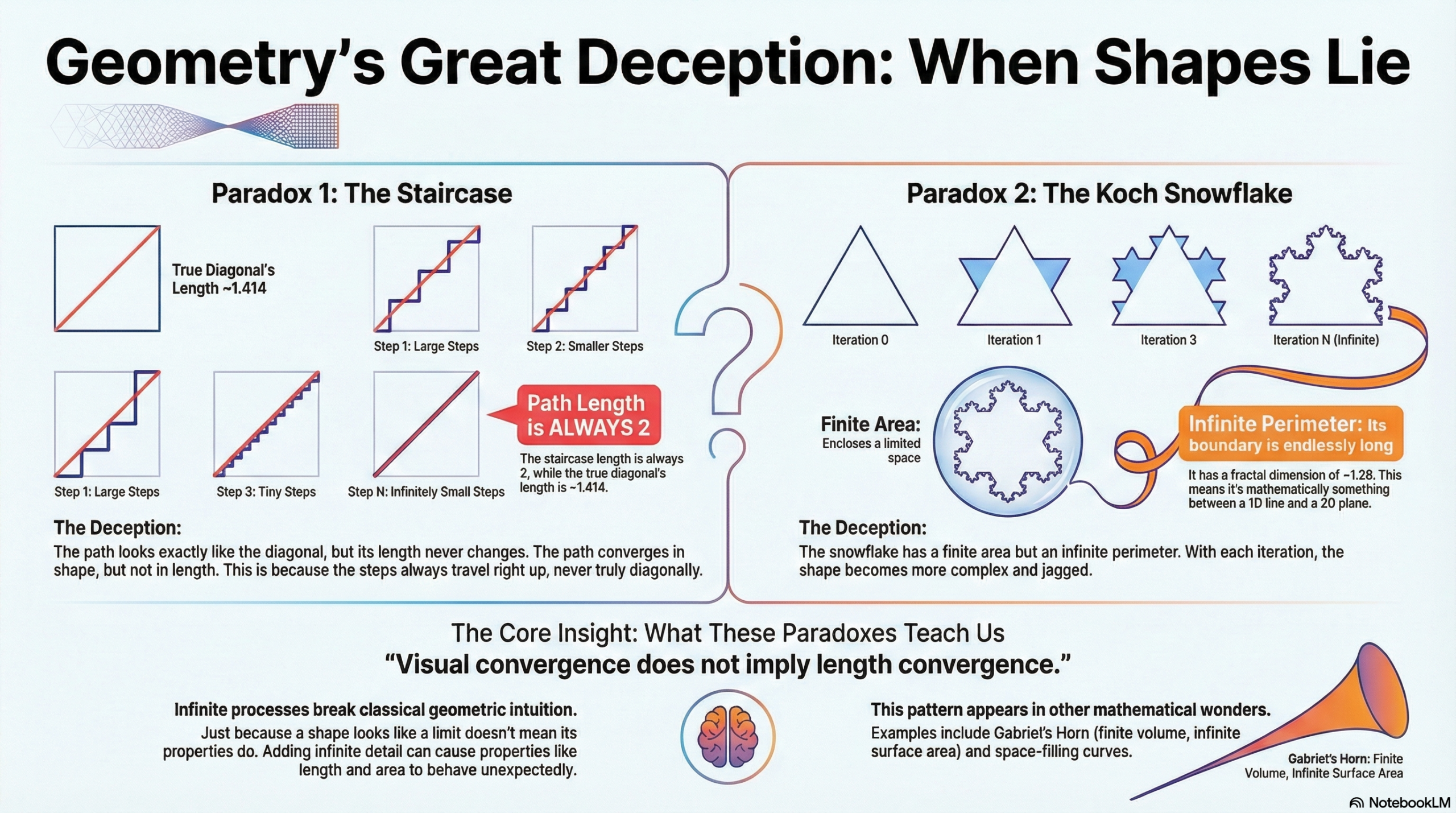
Have you ever looked at a diagonal line across a square and thought, “If I just zoom in enough, surely it’s just a series of tiny steps”?
If so, you’ve stumbled upon one of the most mind-bending puzzles in mathematics: The Staircase Paradox.
This paradox is a classic visual and geometric demonstration used to show how infinite processes can defy our basic intuition
The Setup: A Journey Across a Square
Imagine a unit square (a square with sides of length 1). You want to travel from the bottom-left corner to the top-right corner.
1. The Direct Route: If you take the true diagonal, the Pythagorean theorem tells us the length is 12+12, which is 2
≈1.414.
2. The Staircase Route: Instead of a straight line, you move one step right and one step up. The total length is 1+1=2.
Now, let’s make the steps smaller. If you divide the path into n steps, each horizontal segment is 1/n and each vertical segment is 1/n.
• The length of one tiny step is 1/n+1/n=2/n.
• Since there are n steps, the total length is n×(2/n)=2.
Here is the kicker: No matter how many steps you add, 100, 1,000, or a billion, the total length of the staircase remains exactly 2.
The Paradox of Visual Convergence
As the number of steps (n) approaches infinity, the staircase begins to visually converge to the diagonal. If you plot 200 steps in Python, the staircase looks almost identical to the straight diagonal line.
Logically, you might assume that if the shape of the staircase becomes the diagonal, its length should become the length of the diagonal (2). But it doesn’t. Mathematically, the limit of the length is 2, while the length of the limit is 2
.
This teaches us a vital lesson in calculus: a curve can converge in shape without converging in length
Why Does This Happen?
The core mathematical insight is that uniform convergence of functions does not imply convergence of their lengths.
While the staircase gets closer and closer to the diagonal in terms of position, its “roughness” never goes away. To trace a true diagonal, you must move right and up simultaneously. The staircase, however, always moves right and then up; it never develops the continuous slope required to match the diagonal’s length.
This realization is one of the primary motivations behind advanced mathematical fields like Real Analysis, Measure Theory, and Fractal Geometry. It reveals that limits of functions can behave drastically differently than the limits of their derivatives
The “Cousins” of the Staircase
The Staircase Paradox isn’t alone. It belongs to a family of “pathological” geometric shapes that break our intuition:
• The Koch Snowflake: Similar to the staircase, the Koch snowflake is constructed by adding “bumps” to a shape. As you add infinite detail, the area remains finite, but the perimeter grows to infinity.
• Gabriel’s Horn: A theoretical object with a finite volume but an infinite surface area—meaning you could fill it with a bucket of paint, but you could never paint its entire surface.
• Peano Curves: These are one-dimensional lines that, through infinite “zig-zagging,” eventually fill an entire 2D square
Final Thought
The Staircase Paradox serves as a warning: Approximating geometry by adding detail can break classical notions of length. It reminds us that while our eyes see a smooth line, the underlying “metric properties” (like length) are governed by rigorous limits that don’t always follow the pictures in our heads.
Analogy for Understanding: Think of the Staircase Paradox like a crumpled piece of paper. If you look at a crumpled ball of paper from a distance, it might occupy the same small space as a marble. However, if you were to “un-limit” the process and flatten the paper back out, you’d realize that the actual “length” of the surface was much larger than the space it appeared to fill. Just because something looks like a point or a line doesn’t mean it has lost the “hidden” length of its many tiny folds.
Bonus: A python code that generates a visualization
Here’s a Python plot that visually illustrates the staircase paradox. The staircase path becomes finer and visually closer to the diagonal, yet its total length remains 2, not √2.
You can rerun and modify the code to increase n for a smoother staircase.
Use this code to try different resolutions!
import numpy as np
import matplotlib.pyplot as plt

def staircase_plot(n):
    # Generate staircase coordinates
    x, y = [], []
    for i in range(n):
        # horizontal step
        x.extend([i/n, (i+1)/n])
        y.extend([i/n, i/n])
        # vertical step
        x.extend([(i+1)/n, (i+1)/n])
        y.extend([i/n, (i+1)/n])

    # Plot
    fig, ax = plt.subplots()
    ax.plot(x, y)                # staircase
    ax.plot([0,1], [0,1])        # diagonal for reference
    ax.set_aspect('equal')
    ax.set_title(f"Staircase Approximation with n={n} Steps")
    plt.show()

# Try different n values
staircase_plot(10)
staircase_plot(50)
staircase_plot(200)
Leave a Reply